
Foundations, slabs, footings, structural pours and room additions, built for ground that moves by inches across a single Houston season. This is the structural side of our business, where the soil work below the concrete decides everything that happens above it. Residential and commercial, across Houston and the surrounding communities.
Structural concrete carries building loads. This includes foundations, slabs, footings, structural pours, and room additions. Unlike decorative or flatwork concrete, these elements have a defined load path, and the ground underneath decides how well that path holds up. Local soil, particularly the Beaumont Formation clay common across Houston and Sugar Land, can swell when wet and shrink when dry, creating movement measured in inches rather than millimetres. Uneven support like that is what causes slabs and foundations to bend and crack over time.
Cross Construction Services has more than 10 years of experience pouring structural concrete on exactly this kind of ground. We follow your structural engineer’s plans rather than guessing at foundation requirements. Our work includes excavation, moisture conditioning, compaction, select fill, vapor barriers, reinforcement, and concrete placement. Estimates break these items into separate costs, so you can clearly see how the foundation is being built and where your investment is going.
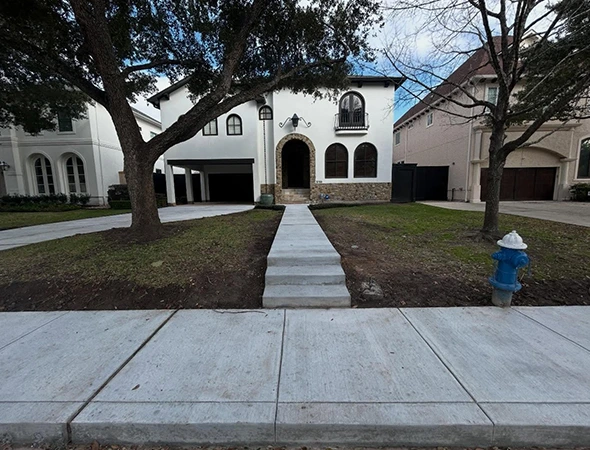
New installation, replacement, repair, resurfacing and widening, plus stamped and decorative finishes. Deliberately not covered on this page: a driveway is flatwork carrying wheel loads, not structure carrying a building, and it gets designed and jointed differently. Plenty of our foundation clients need both, and we will quote them together.
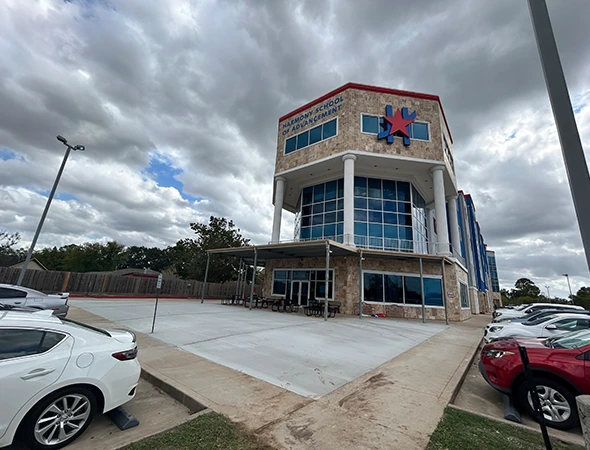
Commercial lots with load zoning for delivery and refuse traffic, accessible space layout, striping and full-surface drainage, phased to keep a property trading. The soil thinking carries straight across from structural work, since a large lot fails from uneven support in exactly the way a slab does.
Foundations, slab-on-grade, footings, structural pours, and the foundation and slab work behind room additions and extensions. Residential and light commercial. This page covers the whole of it, including sub-base preparation, moisture management and reinforcement, which on Houston clay are the substance of the job rather than preliminaries to it.
Solid-roof patio structures, attached or freestanding, tied into an existing roofline with gutters and water management built in. Where a cover is going onto a new slab, it is worth planning both at once so the footings and any posts are set before the concrete goes down rather than drilled in afterwards.
Open-frame structures giving partial shade rather than a solid roof, which is the distinction between a pergola and a covered patio. Cedar and other woods, attached or freestanding, anchored into footings sized for the ground they sit in, which on clay matters more than the timber above.
Sub-base built for stability: Excavation, moisture conditioning, compaction and select fill help create a stable foundation.
Reinforcement is checked before pouring: We verify bar size, spacing, laps, and cover against the drawings before concrete goes down, because reinforcement you can’t see is reinforcement you’re trusting blindly if no one confirms it.
Moisture is controlled around the slab: Vapor barriers, grading, and drainage are planned around the slab from the start, reducing the moisture swings that lead to cracked drywall, sticking doors, and uneven floors later.
Hot-weather pours are planned carefully: Hot-weather pours are timed and managed carefully, protecting strength and finish quality instead of racing the heat and hoping it holds.
Engineered plans followed closely. Drawings are reviewed before work begins, with questions raised early when adjustments are needed.
We assess the site, drainage, access and drawings, then provide a detailed written scope.
Excavation, sub-base preparation, compaction, forming and reinforcement are completed to the project specifications.
Concrete is placed, finished and properly cured, with final inspection before the next trade begins.
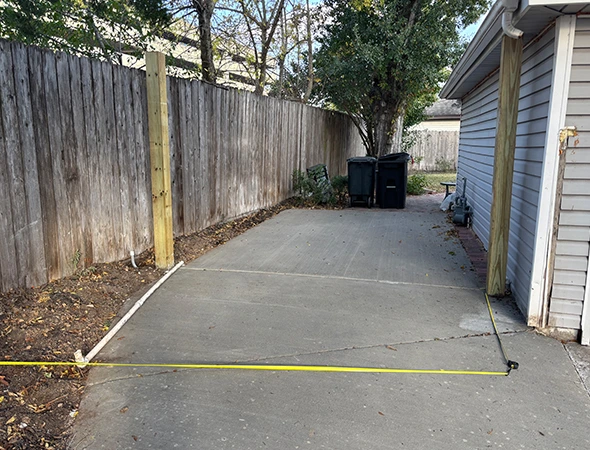
Footings spread concentrated building loads across the soil. In Houston, that soil can change with seasonal moisture. As a result, footing depth and size depend on the site’s conditions and the engineer’s design. Some projects may require deeper or wider footings, while others may use drilled piers to reach more stable soil below the active clay zone.
We pour footings, grade beams, pier caps, column pads, and interior ribs, along with structural slabs and equipment bases recent work has included projects in Missouri City and Greenwood. Three details matter during installation: reaching suitable bearing material, placing and lapping reinforcement correctly, and properly consolidating the concrete. These checks happen before backfilling because the finished footing will no longer be visible.
Need a footing or structural pour quoted? Call 713-854-5949 or send us your drawings.
Home additions require careful foundation planning because the existing house has already settled through years of seasonal soil movement. A new slab can move differently from the original foundation. That can lead to cracked drywall, sticking doors, broken tile, or brick separation at the transition. The connection between old and new construction should be determined by a structural engineer. Depending on the home, the design may connect both structures or use a movement joint between them.
Our role is to execute the approved foundation design accurately, whether that’s an addition on a West University lot or a Bel-Air property with an older original foundation. We handle new footings, slabs, thickened edges, and floor-level transitions around existing structures. Excavation can also reveal unexpected conditions, especially beside older foundations. We address those findings carefully and make sure the finished slab aligns with the existing floor before the next trades begin.
Planning an addition? Call 713-854-5949 to talk through your foundation design.
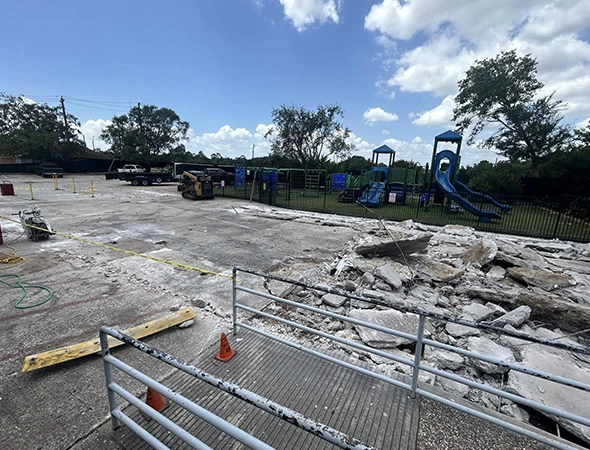
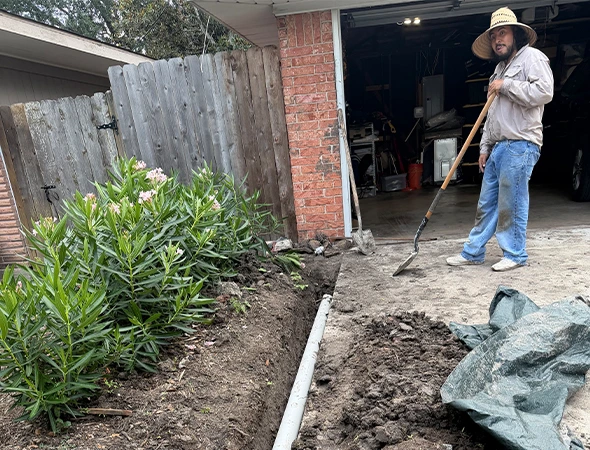
Houston’s clay expands when wet and shrinks when dry. The goal is to keep moisture levels as consistent as possible beneath the entire slab. That starts with proper excavation, moisture conditioning, and layered compaction. Where native clay is unsuitable, select fill may be needed. A vapor barrier can also help limit ground moisture from reaching the underside of the slab.
Drainage around the slab matters just as much. Grading should direct water away from the structure. Downspouts and drain lines should discharge far enough away to prevent water from returning to the foundation. This is a common consideration on League City and Clear Lake lots, where large trees can also create uneven soil moisture as their roots draw water from the ground. Depending on the site, root barriers or moisture barriers may help control these conditions.
Building or repairing a slab in League City or Clear Lake? Call 713-854-5949 for a written scope.
Slab-on-grade is the dominant foundation type across Houston, partly because the high water table and clay-rich ground make basements impractical, and partly because a properly designed slab handles this soil well. Two reinforcement approaches are common, and the choice belongs to your structural engineer rather than to us or to you. It is still worth understanding the difference, because it affects how the foundation behaves and what you can do to it later.
| Factor | Post-tensioned slab | Conventionally reinforced slab |
|---|---|---|
| How it works | Steel tendons cast into the slab are tensioned after the pour, putting the whole slab into compression. | A tied grid of reinforcing bar resists tension once the concrete has already begun to crack. |
| On expansive clay | The slab acts as one stiff plate and tolerates differential support well, which is why it is widely specified. | Works, but relies on the steel engaging after cracking rather than resisting it beforehand. |
| Surface cracking | Generally less surface cracking, though inside corners and pop-outs usually still need added bar. | More prone to visible surface cracking as the soil moves beneath it. |
| Complex shapes | Needs room for the tensioning equipment and defined edges to stress against. | More flexible for heavily articulated plans and awkward layouts. |
| Cutting into it later | Plumbing or structural penetrations need cable locations established first. Not a job to improvise. | Simpler to core or cut, within reason and with advice. |
| Who decides | Your structural engineer, informed by a soil investigation of your actual lot. | Same. The soil report drives the decision more than preference does. |
For anything structural we would strongly encourage one, and your engineer will usually require it. A geotechnical study drills the lot and tells you how deep the active clay runs, what its moisture content is doing and where competent bearing material starts, which is what the foundation design depends on. Without it, a designer is working from assumptions about the most variable thing on your property. It is a small cost against the price of a foundation and by far the cheapest insurance available on the job.
You need a structural engineer, and we will tell you that before quoting rather than after. We are the concrete contractor: we build what the drawings specify, and we do that part carefully, including flagging anything on the drawing that will not build as shown. Keeping design and construction as separate responsibilities protects you, because the person checking the work is not the person who set the requirements. If you do not have an engineer yet, that is the first call to make.
That depends on how the tie-in is designed, which is exactly why it is an engineering decision rather than something to settle on site. Your existing foundation has already found its own pattern of seasonal movement, and the new slab has not, so the design has to either connect them so they move together or separate them deliberately with a movement joint. Both approaches are used successfully in Houston. What causes trouble is neither one being chosen on purpose.
We are a concrete construction contractor rather than a foundation repair company, and those are genuinely different trades. Underpinning, pier installation on a settled house and slab levelling belong to specialists with the right equipment and, usually, an engineer’s repair plan. What we do handle is new structural concrete: foundations, slabs, footings, structural pours and the work behind additions. If you call us about a moving house we will say so honestly rather than take the job.
Concrete shrinks slightly as it gains strength and gives up moisture, so some fine cracking is a property of the material and not a sign of failure, which is why control joints and reinforcement are there to manage where it happens and keep it tight. What matters is telling that apart from movement cracking, which tends to be wider, to run diagonally from door and window corners, and to be accompanied by sticking doors or stair-step cracks in exterior brick. If you are seeing the second pattern, that is worth an engineer looking at rather than a contractor guessing.
Send us the drawings if you have them, and tell us what you are building if you do not. We will walk the site, tell you what the ground is likely to demand, and put a written scope in front of you with the sub-base and steel priced as their own lines rather than buried in a single figure.
Cross Construction Services is a Houston concrete contractor of more than ten years, working out of 4530 Kingfisher Dr. Structural work is the part of the business where we are most conservative, because on clay soil the foundation is the one thing you cannot revisit later without real cost. Call (713) 854-5949 to talk through a slab, a foundation or an addition.
WhatsApp us