
A pergola gives you filtered shade and a real sense of structure without closing the sky off above your yard. We design and build cedar and timber pergolas across Houston, attached to the house or freestanding, anchored into footings that account for how much this ground moves. Proportioned against your house rather than ordered out of a catalogue.
A pergola uses posts, beams, and open rafters to filter sunlight rather than block it. The result is dappled shade with an open view of the sky. Unlike a covered patio, it will not keep you dry during Houston rain. Slat spacing, rafter direction, and the option for shade cloth or climbing plants determine how much shade you receive and where it falls.
Cross Construction Services has more than 10 years of experience building pergolas across Houston, TX, including recent projects in Missouri City. Because the structure must handle wind loads on soil that can move by inches, proper footings are essential. We also focus on proportion, making sure the height, depth, and beam size suit the home. Cedar is our standard choice for its performance in Houston’s climate.
Curious whether a pergola or a solid cover suits your backyard better? Reach out and we’ll walk you through the options.
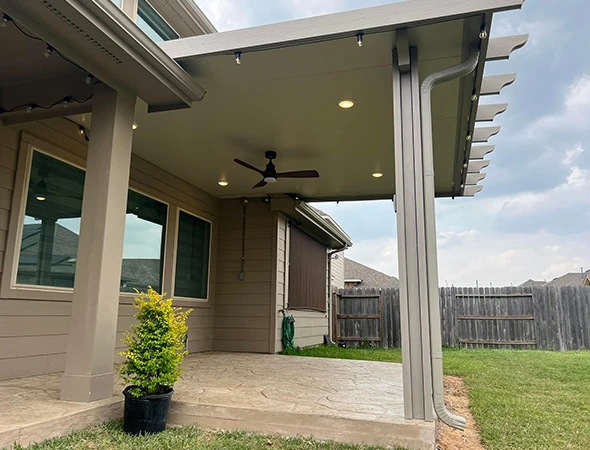
Driveway installation, replacement, repair, resurfacing and widening, in plain and decorative finishes. Worth knowing about here because pergolas often go up as part of a wider outdoor project, and matching a stamped or exposed aggregate patio to the driveway is far easier while one crew is handling both.
Commercial lots with load zoning, accessible layout, striping and drainage, phased so a property keeps trading. Included because we work commercially as well as residentially, and pergolas over courtyards, walkways and amenity areas come through that side of the business too.
Foundations, slabs, footings and structural pours, plus room additions. This is the crew that pours your pergola footings and any new slab underneath it, which is why we can be firm about doing that part properly instead of treating it as someone else’s problem.
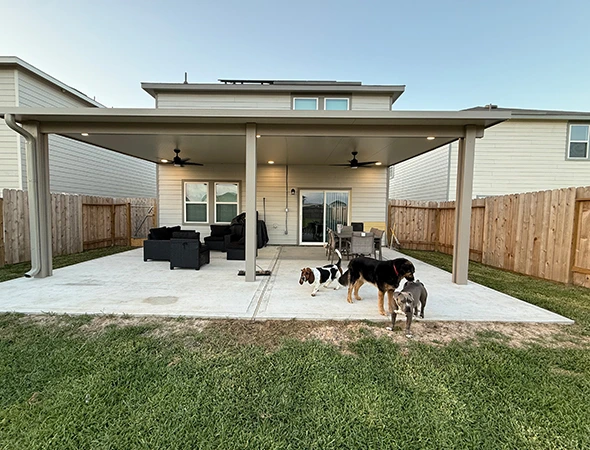
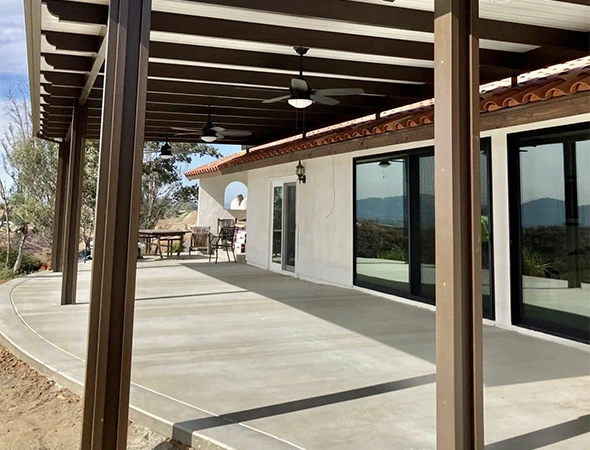
A solid-roof structure, attached or freestanding, that blocks sun and rain completely rather than filtering them. Choose this over a pergola when you want to sit outside through a storm, keep furniture dry, or genuinely beat the worst of August. Some clients build both: a covered patio off the back door and a pergola further out in the garden.
Cedar and timber pergolas, attached to the house or freestanding, custom built and proportioned to the property rather than assembled from a kit. Scope covers design and sizing, footings and anchoring, the frame, slat spacing and orientation for the shade you want, staining, and options like shade cloth or planting. This page covers all of it.
Control the shade. Slat spacing and rafter direction are designed around how and when you use the space.
Build stable footings. Proper footings account for Houston clay movement, wind uplift and structural loads.
Get the proportions right. Height, span, posts and beams are sized to complement your home and sightlines.
Use climate-ready cedar. Cedar handles Houston’s humidity and insects well with the right maintenance.
Plan for future additions. Vines, shade cloth and other features can be supported through built-in fixing points.
We assess the space, sun exposure, slab and house elevation, then provide a clear written estimate.
Proper footings are installed before setting posts, beams and rafters to the agreed design.
Timber is sealed or stained, final fixings are added, and the completed pergola is cleaned and reviewed with you.
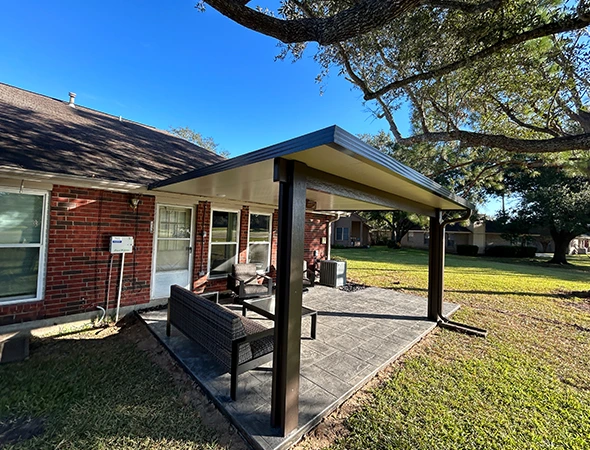
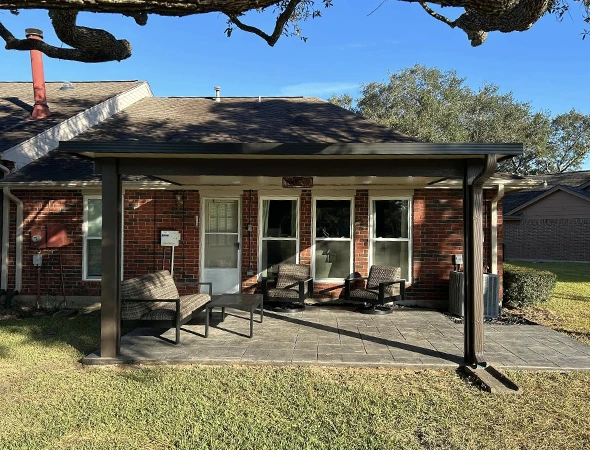
An attached pergola connects to the house through a ledger secured to structural framing. It uses fewer posts and creates a more integrated look. A freestanding pergola stands independently and offers more placement flexibility — a layout we see often on League City and Clear Lake properties, where shade is sometimes wanted further out in the yard, away from the house. It works especially well with brick or stucco walls, low eaves, or yards where shade is needed away from the house.
Good proportions matter just as much as structural support. Height, footprint, and beam size all affect how the pergola looks and performs. A frame that is too low can block views, while one that is too high may provide little useful shade. We size the structure around your home’s elevation, existing slab, and available space before construction.
Not sure whether attached or freestanding is the better fit? Get in touch and we’ll talk through your yard.
A pergola may look lightweight, but wind uplift and lateral movement put significant stress on its posts. Houston’s Beaumont clay adds another challenge, something we account for on every job from West University to Bel-Air. The soil can swell and shrink by inches through wet and dry cycles. Shallow pads or posts bolted to a thin patio slab may not provide enough stability.
Proper footings should be sized for the structure, soil, and expected wind loads. We install deep concrete footings and proper post bases rather than burying timber directly in concrete. If an existing slab cannot support the posts, we can core through it and pour footings below. This extra work helps keep the pergola stable through Houston’s storm seasons.
Want a pergola that’s actually anchored for Houston clay, not just bolted to a slab? Let’s talk footings.
A pergola can provide more shade with tensioned shade cloth or climbing plants. Shade cloth gives immediate coverage and can be removed before severe weather. It can also be retensioned or replaced without changing the structure. Plants offer a more natural look but usually need several growing seasons to fill the frame — something we plan for on installs throughout Missouri City and Greenwood.
Houston’s climate also makes plant selection important. Avoid clinging vines that trap moisture against timber and increase decay risk. Coral honeysuckle, crossvine, Carolina jessamine, star jasmine, and American wisteria are better options when matched to the structure. We can add wires, fixing points, and adequate beam support during construction to handle mature plant growth.
Thinking about shade cloth or a living pergola? We can build the structure to support either.
Timber choice matters more here than in a dry climate, because a pergola is fully exposed on every face to humidity, UV and whatever insects are active locally. Cedar is what we recommend and build in most often. Here is how the realistic options compare.
| Option | What it gives you | What it asks of you |
|---|---|---|
| Cedar | Natural oils that resist rot and insects better than pine, stable in humidity swings, takes stain beautifully and holds a colour. | Refinishing when the water stops beading and the colour starts greying. Those natural oils do diminish with age. |
| Pressure-treated pine | Lower cost, readily available, and treated against decay, so it is a legitimate choice on a budget. | More movement, warping and checking as it dries out, and it wants finishing sooner and more often than cedar. |
| Aluminium | Effectively no upkeep beyond washing, unaffected by rot or termites, and available in wood-grain finishes. | It reads as a system rather than joinery up close, and you give up the detail and warmth timber gives you. |
No, and anyone telling you otherwise is selling you something else. The gaps between the rafters are the definition of a pergola, so rain comes through them, and a tensioned shade cloth will shed some water but is not a roof and should not be treated as one. If staying dry outside matters to you, what you want is a covered patio with a solid roof. Plenty of people build both, using a covered area next to the house and a pergola further out where the open feel is the point.
Rather than give you a number that the weather will not honour, watch the timber itself. When water stops beading on the surface and starts soaking in, or the colour begins silvering off, the finish has stopped doing its job. Sun exposure decides the pace, so a south and west facing frame will always need attention before a sheltered one, and horizontal top surfaces go before the posts. We tell you which product we used so you can match it, and we are happy to come back and do the refinishing.
Some will, which is why plant choice is a construction question and not only a gardening one. Vines that cling with rootlets or adhesive pads hold moisture directly against the timber and encourage rot, so they belong on masonry rather than on a cedar frame. Twining vines that wrap around a beam or a wire are safe, and there are good locally suited options including coral honeysuckle, crossvine, Carolina jessamine and star jasmine. The other thing to get right is vigour, because a plant that wants to cover a barn will eventually load a light frame more than it was built for.
Often yes, because the two do different jobs in different parts of a garden. A covered patio handles the space right off the house where you want shelter and furniture that stays dry. A pergola works further out, over a seating area, a firepit, a walkway or a pool surround, where a solid roof would feel heavy and where you want the sky visible. It also gives a large flat Houston back garden a second focal point instead of one covered area and a lot of empty lawn.
It is possible to plan for, but it is not a small change and it is much cheaper to decide now. A solid roof adds weight and, more importantly, catches wind in a way an open frame does not, so the posts, beams, connections and footings all need sizing for that load from the outset. If you tell us at the design stage that a solid cover might follow, we can build the structure to accept one. If you do not, converting later usually means significant rework rather than simply adding panels on top.
It is the most common question we get, and it is easier to answer standing in your yard than over the phone. Tell us how you want to use the space and we will tell you which structure fits, where it should sit, and roughly what each would involve. If a covered patio is the better answer, we will say so.
Cross Construction Services builds concrete and outdoor living structures across Houston and has been doing it for more than ten years, from 4530 Kingfisher Dr. Pergolas are the job where our concrete background shows most clearly, because what keeps an open frame standing straight on clay soil is entirely what happens below the posts. Call (713) 854-5949 to talk through your yard.
WhatsApp us